








Demna Gets That Gucci Is Defined by the People
The designer’s debut show was met with widespread criticism—but are people missing his point?

Demna Gets That Gucci Is Defined by the People
The designer’s debut show was met with widespread criticism—but are people missing his point?
Demna’s runway debut for Gucci last Friday was arguably the most anticipated show at Milan Fashion Week, but with that comes the scrutiny endemic to leading a “superbrand” like Gucci. Furthermore, if your name is as polarizing as Demna’s, you’re sure to ruffle a few feathers.
Expectedly, the runway show veered in a direction different from Sabato de Sarno’s two-year run, but stood in particular contrast to Alessandro Michele’s two-decade tenure. Whereas Michele indulged in ‘70s maximalism, logomania, and busy patterns, Demna instead returned to the sexy minimalism of the brand’s first non-Gucci creative director, Tom Ford, who arrived in 1994.
“I don’t want it to be intellectual, but I want Gucci to be a feeling,” Demna said in a letter ahead of the debut. At the finale, Kate Moss wore the iconic Gucci G-string unveiled at Tom Ford’s SS97 show—arguably the moment Gucci, the feeling, began.
View this post on Instagram
Some critics saw the presentation as lackluster, and some went as far as comparing the collection to fast fashion brands. Indeed, models like Gabbriette and Emily Ratajkowski walked the runway in short, skin-tight numbers you might see at a shop like Fashion Nova. Memes and comments also likened their exaggerated movements to NPCs from Grand Theft Auto. Standing out among the male models were emerging underground rappers like Fakemink and Nettspend, dressed like they were pulling up to the afterparty rather than the show.
Has Demna committed sacrilege against the house of Gucci? Or might he actually be onto something?
“Gucci is not a “maison”, it does not have couture roots, it’s not based on a myth. Gucci is a superbrand that is as much about pragmatic product as it is about emotion.” — Demna
Established in 1921, Gucci’s rise differs from competitors like Louis Vuitton and Hermes, who originated in the 19th century. The Florentine brand was founded at a time when new forms of marketing and manufacturing fueled growth across all industries, making branding more essential. “Gucci is not a ‘maison’, it does not have couture roots, it’s not based on a myth,” said Demna. Instead, he calls Gucci “a superbrand that is as much about pragmatic product as it is about emotion.”
The “Primavera” collection was certainly pragmatic, and one could even say it was full of “regular” clothes: blank polos, t-shirts, jeans, leather jackets, and body-con dresses outnumbered the more ornate showpieces. With pretty much zero graphics, the Gucci-ness came from subtle branding: the Milanese red-and-green stripes and a modest dose of its signature monogram patterns.
UK-born rapper Fakemink’s pared-back look (black skinny jeans, a black tee, and a monogram crossbody) evoked images of how ordinary people wear Gucci IRL today. Memes immediately flooded the internet with one user commenting, “everyone in Marseille dressing like this,” while another said, “baby, this IS the French Algerian fit.”
View this post on Instagram
Contrastingly, Nettspend wore Gucci exactly like a so-called ‘SoundCloud rapper’ would, with a lavender snakeskin t-shirt, silver skinny jeans, high-top sneakers, and another crossbody bag. As one of the most flamboyant menswear looks of the show, the flashy number bore the brunt of online critiques.
Demna, more than other designers, tends to be a target of heightened scrutiny, and his appointment to Gucci was no different. When the Georgian-born designer was announced as the successor of former creative director Sabato de Sarno, the internet was abuzz with skepticism and speculation about where Demna would take Gucci next.
Understandably, there was a high expectation of some form of “ragebait” gimmick. Not long ago, Demna released a $925 USD Balenciaga towel skirt. From his Vetements DHL uniforms to his Balenciaga Crocs stompers, the designer has always challenged tastes and expectations by repackaging the everyday.
At Balenciaga, that meant completely re-engineering what the brand meant in the 21st century, upping its edge with humor, irony, and reintroducing oversized silhouettes (during the height of slim-fit). His FW16 debut added puffers and nylon shell jackets to the Balenciaga woman’s vernacular, and for FW17 menswear, he debuted the Triple-S sneaker, an especially polarizing silhouette.

Vogue Runway
Vogue Runway
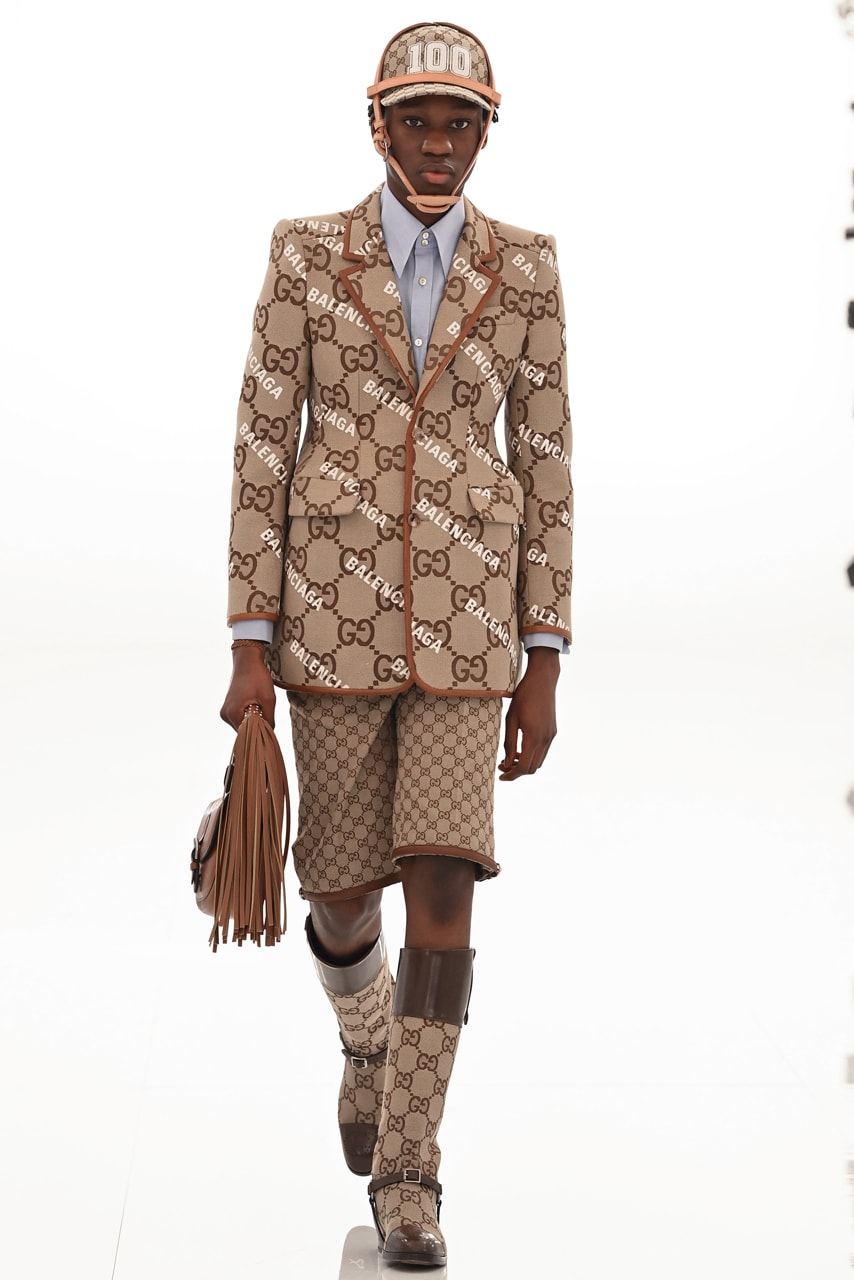
Whether you enjoy his work or not, there is no denying that Demna’s ambitious pivot clarified Balenciaga to a new generation. The designer’s approach to fashion has always had a subversive, democratic slant, in that his garments often expand the limits of luxury by elevating pedestrian styles to a premium status. Whether it was collaborating with 18 brands for Vetements SS17 or his 2021 Balenciaga x Gucci “hack”, he has always treated luxury brands as flexible and malleable rather than stagnant and unchanging. His work raises interesting questions about who luxury is really for and what can be considered a luxury today.
With discourse surrounding counterfeit products, artificial intelligence, and celebrity brands running rampant, authenticity has become a central focus for luxury brands. While this has translated into a nostalgia for archival design and vintage branding, Demna argues that the immediacy of “fashion” is just as vital.
The case of Dapper Dan highlights how, as much as fashion has historically trickled down from the runway to the street, it is increasingly trickling from the street to the runway.
Ridley Scott’s fictionalized biopic, House of Gucci (2021), illustrated this perfectly: Patricia Reggiani (Lady Gaga) scolds her husband, Maurizio Gucci (Adam Driver), for allowing counterfeits to prosper. His uncle, Aldo Gucci (Al Pacino), retorts, arguing that the fakes are a sign of Gucci’s legitimacy as a force in luxury.
The scene brings Harlem-born tailor Dapper Dan to mind, who began remixing designer logos into custom garments for legendary rappers and Harlem’s Black elite in the ‘80s. This reclaiming of designer icons for the culture continues to inform how brands like Gucci are represented in hip-hop through stage names like Gucci Mane and song titles like “Gucci Gang” by Lil Pump. After decades of borrowing the Gucci logo for his bold creations, the legendary designer was finally invited to collaborate with the brand in 2017 under Alessandro Michele.
The case of Dapper Dan highlights how, as much as fashion has historically trickled down from the runway to the street, it is increasingly trickling from the street to the runway. Importantly, it also shows how sometimes the most impactful and innovative ideas in fashion come from the marriage between the brand’s essential identity and how the masses actively evolve and adapt it.
“My vision of Gucci is about the coexistence of heritage and fashion. Here, they are not opposites; they are lovers. Gucci only exists when both are in sync, when both nourish each other.” Demna conveys that “fashion” (perhaps interchangeable with trend-driven clothing and commerciality) is not antagonistic to heritage; instead, they build on one another.


