








Getting Down & Dirty with Li Hei Di


Li Hei Di was Pace’s youngest artist when they joined the mega-gallery in 2024. In just a few years, their atmospheric dreamscapes propelled them into the ranks of contemporary art’s most promising new painters. “There’s me, and there’s sugar-coated me,” Li tells me from beneath one of several majestic canvases in their ongoing New York solo. Judging by the cloudy menageries of severed limbs overhead, in the year of mud, the London-based artist is ready to scrape off the sweet stuff.
“It feels like I’m stumbling through mud, but also a part of it — I can reshape myself,” they express. “It’s all about turning a muddy situation into a beautiful one.”
The Shenyang-born, London-based artist is just getting started. After completing their painting MA from the Royal College of Art, Li has shown work at Linseed Projects, Michael Kohn Gallery, and Pippy Houldsworth Gallery, with now three presentations with Pace under their belt. Spanning deep blues and purples to blushing sunset hues, their works pull from an eclectic mix of inspirations. Because sincerity, be it in bell hooks or survival reality TV, books wrought with grief or Hoppers, as Li points, has no one medium. They see painting as a raw, expressive “language” to get at truths and tragedies of life, sex, desire, and emotion, unearthing them from the ten-dollar art jargon they’re so often buried beneath.
On and off the canvas, Li’s on a transformational run. You’d think a career full-send this early on would set the tensions high, but for Li, painting is still the escape. During their last solo exhibition, land marks, they began medically transitioning, having reached a point where gender dysphoria and the fear of coming out came to eclipse their burgeoning successes. “I already made the scariest decision of my life, so everything exterior, materialistic, doesn’t matter that much.” These days, Li’s got little interest in playing it safe. Having shed the need to fit so neatly into a box, they’re finally painting on their own terms, and the newfound freedom meant more risks in the studio. Earlier celestial bodies meld into human ones, a figurative turn that long felt out of reach. “Because I conquered that fear, there was nothing to lose.”
For this new installment of Hypeart Visits, Li takes us through their year of mud, how a Pixar film inspired some of this latest painting suite, and why the secret behind their breakthrough was simply letting go.


“I kept painting because it’s meditative. It’s like a conversation where no one’s going to judge you — a language without the intimidation of words.”
This is your third go-around with Pace. When did you embark on this body of work?
Last fall. I started seriously making this body of work last November, but I started some of them earlier. I started this one, “we swallow what recedes that new life,” around September, actually. It was a nightmare. I kept changing it. I went through so many different versions of it; it looked completely different before.
It’s the one I spent the most time on. When you work on something for a long span of time, you, as a person, change. You look at it and don’t identify with who you were three months ago. You have to make it anew.
What makes a good title for an artwork?
I was really straightforward with the titles for some. I used to think I needed something poetic. But this time, it is what it is. This one’s called “there is no time for dicking around.”
That one is “finger my brain.” There wasn’t a finger there before. The morning they were going to ship the work, I felt really anxious. Most of my panels are made in my studio, but because I took these small ones home, I painted the finger half an hour before they picked it up.
Does instinct like that always play into your process?
For the smaller works, it’s a matter of chance. Every time I feel like a painting is fucked, there’s a turn of events. It feels very magical, like a god saved my ass. I can feel him, hear him saying, ‘You’re not going to be this lucky next time.’
Do you keep any rituals or routines before approaching a canvas?
I don’t like to plan anything; it gives me stress. I try not to pressure myself so much. When I was growing up, everything was so strict, so sometimes I do indulge. Now, if I want to buy a big LEGO set, I’m going to buy the big LEGO set.
What environment do you thrive in?
I need to listen to something when I’m painting. Even when I wake up, when I brush my teeth, I’ll listen to American politics. I’m not actually listening, but I need people talking really seriously. It helps set the tone for a serious day.
In the afternoon, it can be a podcast or an audiobook. Sometimes I avoid listening to music. It makes me too emotional. It feels like opening a blind box. I really like Rosalía, though. I’ll listen to her for a week straight and still hit a cry point.


“Because I conquered that fear, there’s nothing to lose.”
Up until now, you’ve mostly painted hazy forms, and now bodies are coming into focus.
I used to be really afraid of solid shapes in my work. There’s me, and there’s sugar-coated me. The new pieces are what happens when we scrape it off. Like, before I would’ve never thought to make a dark painting. Teachers told me you should never use it straight out of the tube, or use a dark blue to make it more interesting. This is me being like, ‘Fuck it. I’m going to use black.’
What made you take that creative leap of faith?
It’s been a really crazy year. I started medically transitioning last December, and that’s been a really big fear for me for years. I never thought I would actually do it. I thought I could still live this way — ‘It’s just a body’ — but then it came to a point where I felt like if I didn’t transition, I couldn’t continue.
Before, I felt like I could only do serious subject matter, but I stopped caring and just painted whatever I wanted to paint. I already made the scariest decision of my life, so everything exterior, materialistic, doesn’t matter that much. Because I conquered that fear, there’s nothing to lose.
At one point, you were Pace’s youngest signee upon signing in 2024. How do you handle the pressure or expectation that comes with a title like that?
All of it hasn’t settled in because when I started with Pace, I’d been battling this gender dysphoria. It was my main focus. It took so much of my brain power. Yeah, I was definitely stressed about painting, but I spent the whole year worrying about telling my parents. Painting became this fun thing that I get to do. With painting, you can be completely honest. It’s not just creating an epic scene for people to enjoy. It has to be raw.
Was it always an outlet for you?
When I was younger, I mostly drew and began painting oil as a junior or senior in high school. I kept painting because it’s meditative. It’s like a conversation where no one’s going to judge you — a language without the intimidation of words.
I found out I’m really dyslexic, so I’ve always been afraid of words. All of the shapes evoke different, specific emotions, and that was exactly what I was afraid of before: I was afraid of shapes because I was afraid of these emotions. It’s kind of symbolic.


If you don’t want to see cruelty, it’s still a colorful picture. But you can also see the tragedy of life or sex, if you’re willing to dig further.
What do you gravitate toward when you’re uninspired?
I really like novels, and now I’m able to use shapes to orchestrate something more like a novel. I like Li Yiyun. She’s based in New York, but from mainland China. She only writes in English because, in Chinese, it feels like there are so many eyes on you. That’s exactly how I feel. The culture you grew up with, even love, it castrates you. I only write in English and make paintings because Chinese, to me, is so serious. It feels like all of your ancestors watching you.
Walk us through the largest piece in the show, “it is time unspooling past time.”
I can’t believe I did this. I made this in August, around the time I needed to tell my parents about my transition. This is exactly how I felt. The little windows up there look like the Spirited Away train driving through the water. I wanted to make this one really intense, toxically magenta and green. Something that’s so insanely artificial, but also exists in nature. I wanted to make it like a dreamland.
What is a main influence for the palettes you’re working with?
I get inspired by cinematography and photographs I took while traveling. This one started from a National Geographic picture of the Northern Lights or something.
What’s something you wish people knew about you?
I wish they knew I was funny.
How does your sense of humor translate into the work?
My work is funny and sad at the same time. I saw this Disney cartoon called Hoppers. I loved it. that’s why I painted butterflies. A lot of people think, ‘You transformed, so here’s a butterfly.’ But actually, I got it from the movie. The butterfly [in Hoppers] comes out, and she’s all beautiful and scary, but then she gets squished. That’s how I feel about my painting. It’s like when the protagonist dies, and everyone just laughs about it. It’s very sickly, but also, that’s life.
If you don’t want to see cruelty, it’s still a colorful picture. But you can also see the tragedy of life or sex, if you’re willing to dig further. The challenge of my work is figuring out how to piece these things together so they don’t feel forced, how to do it in a way that feels organic.
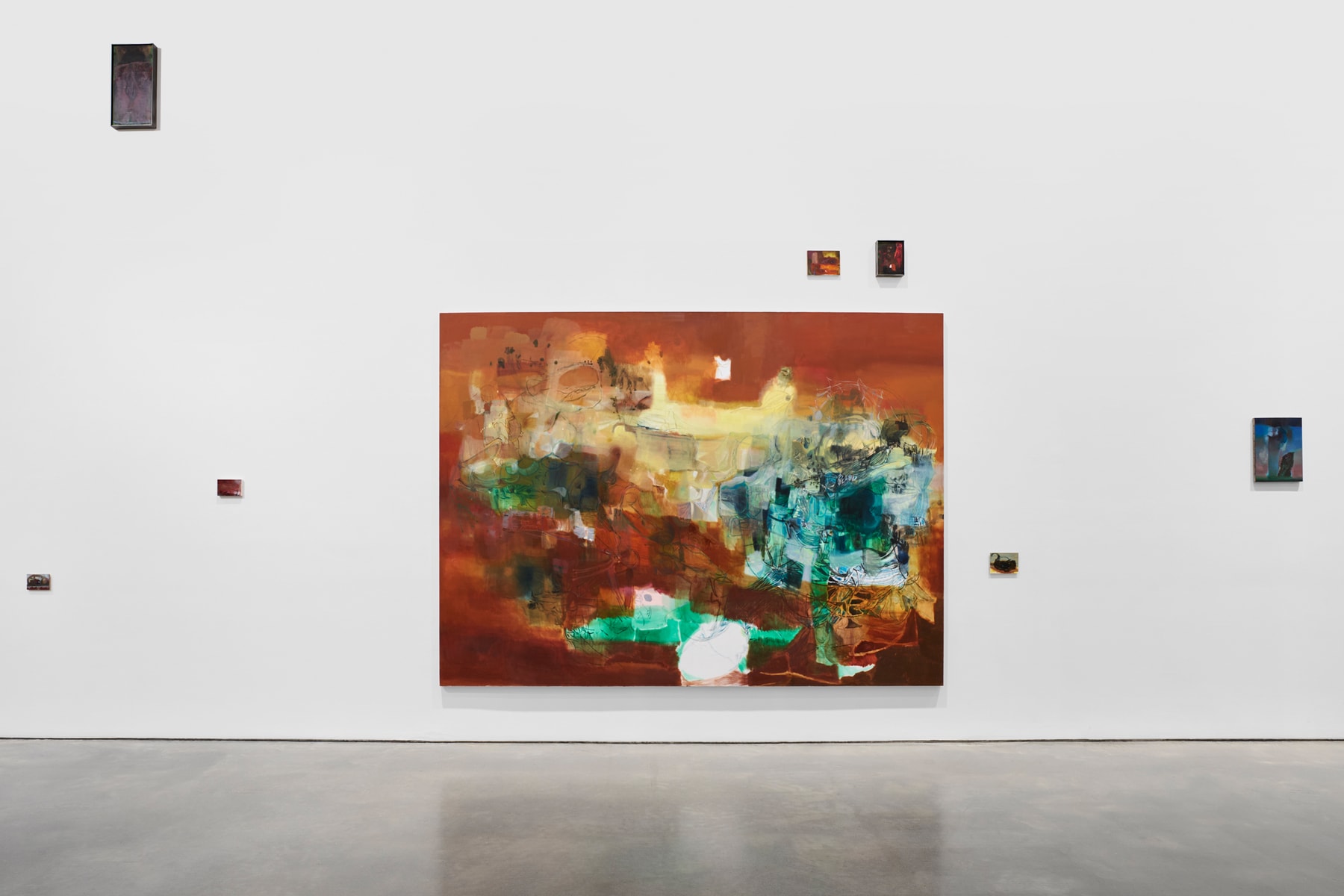
So, what is your year of mud?
To be honest, I just wanted to call it that. It kept popping up for months while I was painting. In the middle of it, too, there were a lot of things going on. I was really stressed about life. It feels like I’m stumbling through mud, but also a part of it — I can reshape myself. It’s all about turning a muddy situation into a beautiful one.
How do you see this newfound confidence shaping your future work?
I don’t have a plan. I like painting because you can really expand your code of language. It’s an endless alphabet, an endless combination of possibilities. I really just want my technique to evolve and not repeat the same thing. But don’t mark my words. We’ll just see what happens.
Li Hei Di’s year of mud is now on view at Pace New York until December 19. Photos courtesy of Pace Gallery and Vogue China


