










Playboi Carti: Behind the "MUSIC"
Playboi Carti
Behind the “MUSIC”
Words by Paul Thompson
Photos by Gabriel Moses

This article originally appeared in Hypebeast Magazine Issue 35: The Wavelength Issue.
Five years after his magnum opus shattered rap, Playboi Carti returns to survey the ruins.
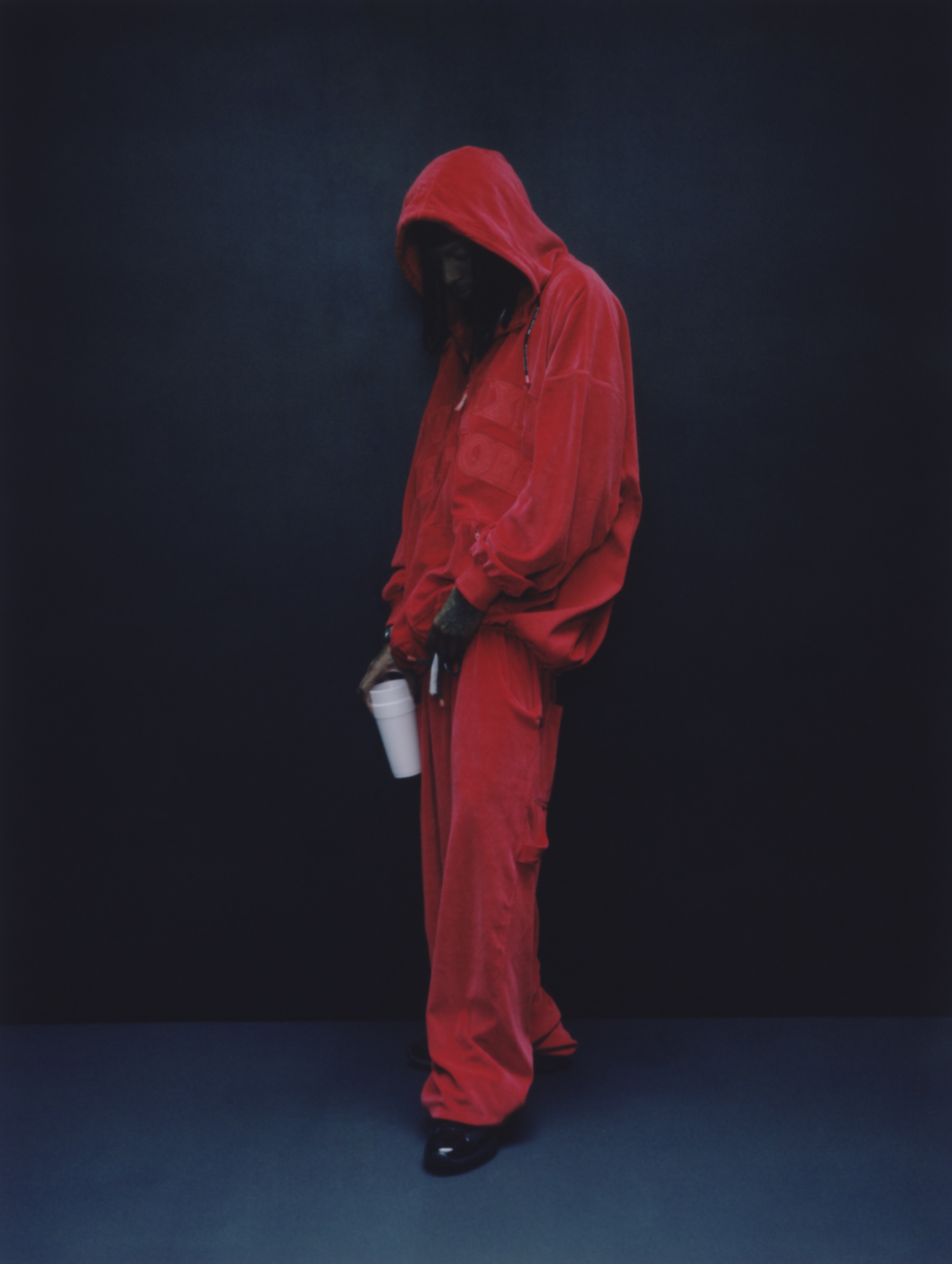
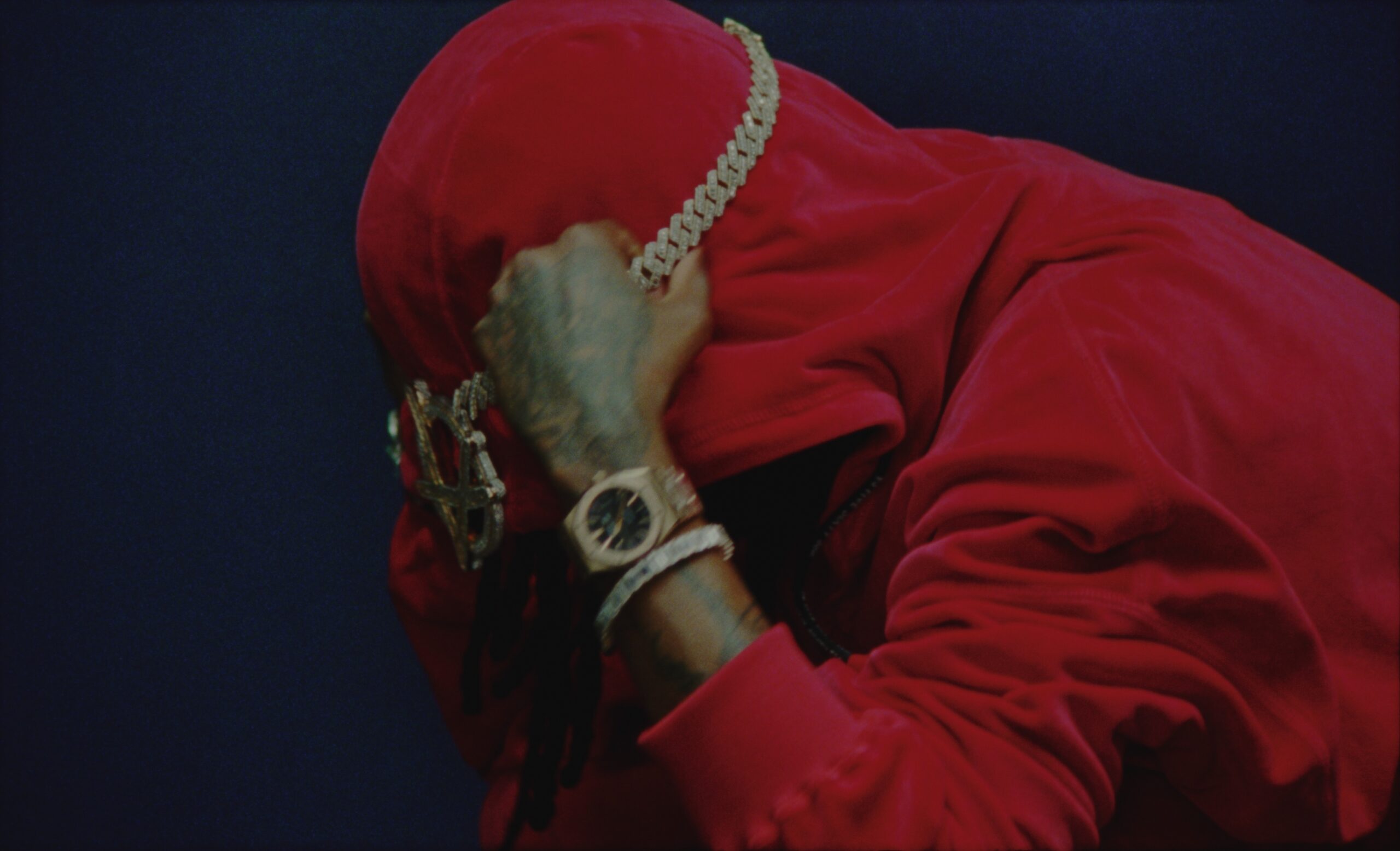
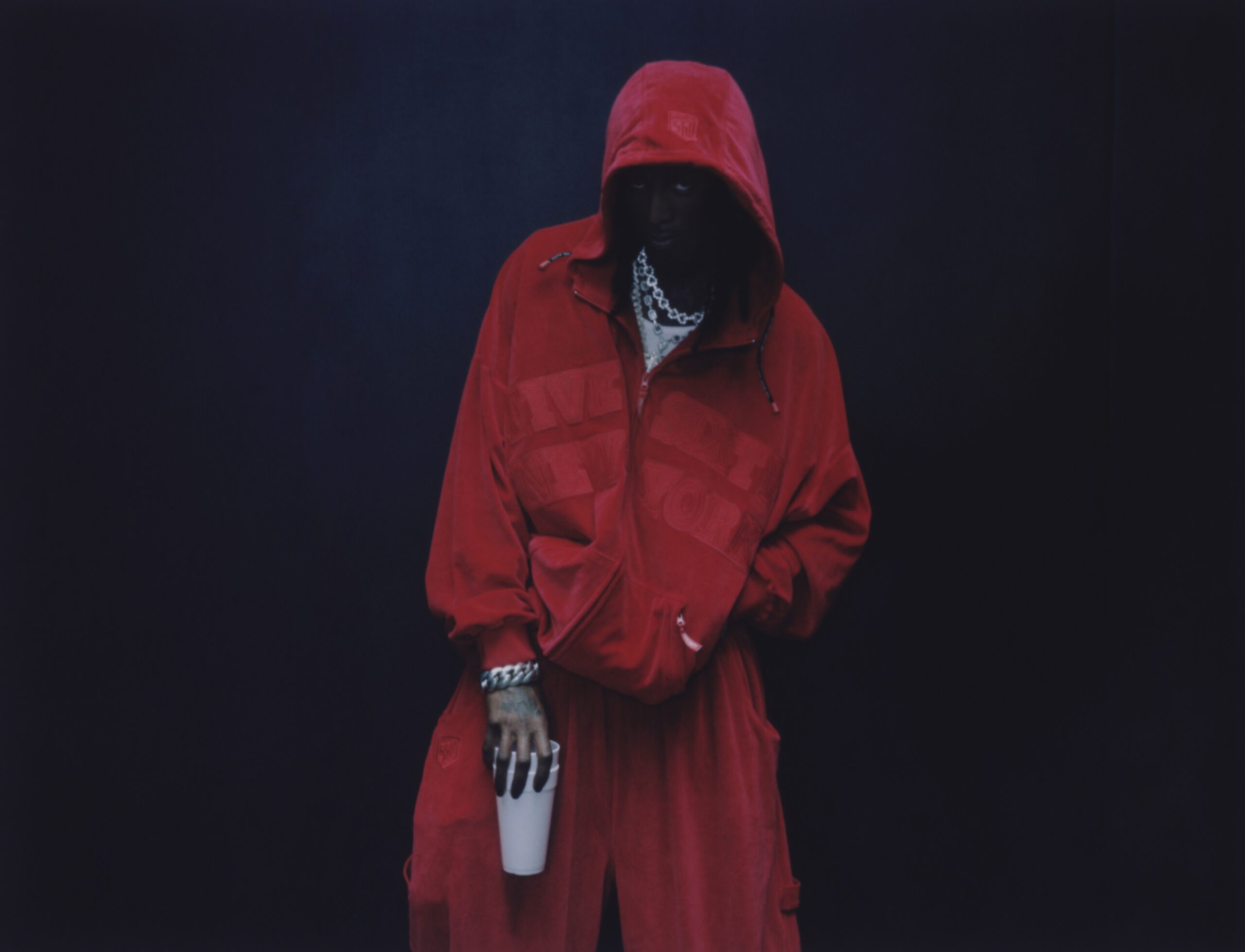
When the people at Hypebeast asked me to write an essay on Playboi Carti and explained that it would run opposite a series of original photos, the notion that there would be new portraits of the nearly skeletal 29-year-old auteur draped in fabrics sure to be billowy, expertly chosen, and astronomically expensive was almost unbelievable. For someone whose influence is so ubiquitous, Carti himself is strangely scarce. Few musicians have his interest in or eye for fashion; fewer still can tweak and twist their bodies in such a way that can seem at turns vampiric or downright pellucid. And, somehow, it seems odd that we would be able to capture an image of the man at all.
His white-hot masterpiece, Whole Lotta Red, is without question the defining rap record of the decade so far—the common ancestor for a half-dozen different subgenre offshoots and many more careers. The particular way he conflates ad-libs and main vocal tracks, the de- and reconstruction of language within his verses, even the irrepressible energy he projects in his frequent stage-whisper asides have become a lingua franca for otherwise divergent groups of young rappers all the way from Carti’s native Atlanta to the far reaches of Scandinavia. Until now, WLR, released on Christmas of 2020, was his most recent studio LP. Even his smattering of excellent follow-up singles were mostly kept off of digital streaming platforms, leaving vultures to pick at carcasses strewn across YouTube, Soundcloud, and Instagram Live.
And so the vacuum was filled by rumors: Carti is in Toronto; he’s back home in Atlanta; he’s at the top of one of the more serpentine roads in the Hollywood Hills; he’s holed up in a cave near Paris like a bat that owns a lot of Rick Owens. Producers hint in interviews that they’ve been brought in to help him flesh out a new sound, or refine an old one. Release dates for a Whole Lotta Red sequel come and go, come and go. Pre-order links and whispers of tour plans vaporize almost as soon as they appear. A friend summarizes the phenomenon best, posting a picture of a still-standing World Trade Center to his Instagram story with the caption “9/11 if Carti said it was happening.”
Then, at once, the wait was over. In the early-morning hours of March 14th, MUSIC (more often referred to by the title Carti had teased, I AM MUSIC), finally materialized—30 tracks that run more than 75 minutes but do not sprawl so much as move in concentric circles, spending most of their orbit in the half-decade of hip-hop that Carti shaped, then poking, at least intermittently, into the unknown. It’s at moments eerily familiar and at others truly alien.
MUSIC seems, at the time of this writing, like a pulse that will jab Carti into the true main vein of pop culture: a run supporting The Weeknd on his stadium tour will surely be followed by a swath of solo headlining dates; the merch will be inescapable; the LP will dictate even the parts of summer radio programming that it does not itself comprise. And yet, instead of each new discrete moment of exposure bringing Carti more fully into view, they instead seem to make him more opaque. This is not a file of surveillance videos—imagine instead a stack of transparency sheets from an old overhead projector, slightly askew such that the borders blur and the details grow fuzzy. He’s here. He isn’t.

Carti was born the day 2Pac died: September 13th, 1996. (That this became something of a joke on the rap internet speaks to both the reverence with which fans almost immediately treated Carti and the way real-world tragedy now effortlessly collapses into ones and zeroes.) He was raised in South Atlanta, began uploading tracks to Soundcloud in his early teens, then kicked around the fringes of Awful Records and the A$AP Mob, respectively, before and after a move to New York City. In short order, he was signed to Interscope Records just as the major labels were becoming newly flush with streaming cash.
Even then, he was elusive. Fans — young, largely male, hyperfluent in the language and symbology of the internet — clamored for the release of songs that were previewed in vanishingly brief snippets and lived (until Interscope was ready to issue them) under a variety of titles and in wildly unpredictable fidelity, on YouTube and what was left of the old file-sharing networks. Across rap’s history, this bureaucratic purgatory has ensnared a shocking amount of great music, held up due to clearance issues, executive apathy, or any number of other factors. Whatever the animating force might have been, for Carti, the ephemerality seemed to become part of the larger project.
In the spring of 2017, his debut mixtape — the cover art for which is, aptly, the same photo produced twice over — embraced the sense that a whole style, even a radically new one, could be assembled with what seemed to be the auxiliary elements of old ones. Playboi Carti was led and characterized by “Magnolia,” the minimal, menacing Pi’erre Bourne-produced single that had long rattled around message boards and Twitter group chats, usually titled some variation of “Hide It In My Sock.” The song builds tremendous momentum despite, or perhaps because of, the fact that most of the vocals could be mistaken for things Carti would mumble in the booth as he was clearing his throat while preparing to rap in earnest.
The self-titled release was followed just a year later by Carti’s “debut” album (a meaningless contractual distinction), Die Lit. This time Bourne handled an even greater share of the production, which helped thread together an array of songs that, without the hint of a shared sonic syntax and such careful sequencing, could otherwise be read as a string of disconnected genre experiments. Like his early collaborator, Lil Uzi Vert, Carti took to describing himself as a rockstar: stage diving on the album cover and making the mosh pits/broader chaos of his live shows not just the organizing logic for his songs, but often their very text.

The two-and-a-half years between Die Lit and Whole Lotta Red were defined by a series of leaks, canonized almost immediately by his increasingly cultish fanbase. (There are metrics by which Carti’s Yung Nudy collaboration — unfortunately titled “Pissy Pamper” and never properly released — could be seen as one of the most significant songs of the late 2010s.) Carti’s opacity is such that it’s unclear whether these leaks caused significant delays and/or wholesale changes in aesthetic direction, or were simply excised from an otherwise static album-in-progress.
In any event, the wait for WLR bred comic levels of impatience, only to be rewarded with a staggering work of sonic and emotional dynamics. Doing away with the primary-producer model, Carti roped in a cadre of newcomers, including F1lthy, widely credited as one of rage rap’s forefathers. The result is something that sounds, when it isn’t so heavy as to bludgeon a skull, like a buzzsaw cutting through a GameBoy Advance. That Christmas, I reviewed WLR for Pitchfork, where it was stamped with the prestigious Best New Music seal. To this day, I get messages from strangers who are livid with me for the score itself (8.3) being, in their estimation, not high enough.
In Carti’s absence, Whole Lotta Red has only grown more essential — a Rosetta Stone for five years of experimentation and refinement, influencing an entire industry’s worth of rappers and producers. Imagine, again, that stack of projector transparencies. Now imagine them being peeled away, one by one, by artists and A&Rs who would go on to build entire songs, albums, and even careers off of a single element of that record. Naturally, the alchemy has not been recreated; where imitators have pulled strings one at a time, Carti makes marionettes milly rock. Fitting, since the puppeteer spends most of his time off stage.
The drought between Whole Lotta Red and MUSIC made it seem like the prior gaps in Carti’s catalog had been mere blips. This time, the signal-flare promo singles were released with more evident intention, but still held off of DSPs. Fans cataloged Carti’s every move with familiar diligence, but a new nihilism had set in: the album, the tour, the next round of merch — none of it was ever coming, they joked. He’s in Houston, now, or maybe London; he’s in Marrakech; he’s in the studio with Pi’erre again; he’s trying new designer drugs with Kanye; he’s bulking up for Milan’s fashion week; he’s slimming down for New York’s.
What was clear, however, was that he was rapping with as much force and intuition as ever, his vocal elasticity, uncanny sense of rhythm, and slyly outré imagery in perfect ensemble. See “Different Day,” which is delivered like a breathless, middle of-the-night account of a terrible dream; see “H00DBYAIR,” which, mercifully, made the final cut and imagines that the creative explosion of circa-2014 Atlanta rap took place, instead, in hell.
MUSIC is not the paradigm-warping force that Whole Lotta Red was, either for Carti or for rap writ large. It ingests and spits out far more varied and interesting sounds than just the rage and rage-adjacent rap that exists in WLR’s wake, but the sound palette, tempos, and guiding sensibilities are similar enough that you’d expect it to be received as an extension rather than reinvention. And while it justifies its length and seldom drags, the LP as a whole lacks the inevitable, irreducible quality of its best songs, letting MUSIC drift, at times, dangerously close to .zip file territory.
Fortunately, even when caught flat-footed, Carti is able to collect himself and exert almost unbelievable amounts of gravity. The relative retread “OLYMPIAN” is salvaged immediately by “OPM BABI,” a delirious inversion of soul-sample song mechanics. That the A list features (Future, The Weeknd, Travis Scott, Kendrick Lamar) are almost superfluous only underscores Carti’s marquee status. If not uniformly engrossing, MUSIC is at least frequently hypnotic.
Sometimes it even makes that bent toward hypnosis literal: On “Cocaine Nose,” what sounds like the chirp from a W. Bush-era Nextel phone echoes under the chorus, like a sonar looking for Instagram models. That’s far from the only relic of the past that Carti repurposes here. DJ Swamp Izzo, a fixture on the mixtape circuit that helped break many of those same 2014-vintage Atlanta artists, hosts MUSIC, his bark littering tracks and injecting them with his frantic, towel-me-off urgency. But contrary to what he says at the beginning of “Munyun,” you do not have to be living “under a rock” to be unfamiliar with him — you might simply be under 30. This plays differently than when, for his 2021 album Call Me If You Get Lost, Tyler, the Creator enlisted DJ Drama to host and cast the LP as a mixtape from his Gangsta Grillz series. Where Tyler was mining nostalgia, Carti seems more interested in collapsing time altogether.

In this process of collapsing time, he also dubiously revives the soft fuzz of early 2010s popular EDM. MUSIC is often as delirious as Whole Lotta Red, but it is seldom as heavy. Carti could never be accused of complacency, but there are stretches of MUSIC where he never quite reaches a point of catharsis or release. While there’s “Cocaine Nose,” as well as explicit reference to molly, it’s ketamine — the original title of a song that appears here as “K Pop” — that is probably the most apt drug analog, known for its soft and dissociative effects. On “Fine Shit,” the chorus’s final line (“Don’t say you’ll die for me, lil’ bitch, just die”) sounds less like a dare or provocation and more like permission to embrace a long-awaited conclusion.
And still, MUSIC is too idiosyncratic to stay forgettable. The stabs of choral vocals that punctuate “Crush.” The flitting between vocal registers on “Rather Lie.” The way he contorts his vocals around Kendrick’s ad-libs on “Mojo Jojo” to make it sound like the LA legend is simply another one of his alter-egos. All of these flourishes make the album, immediately and obviously, unlike dispatches from any of his peers or his children. When he quips, also on “Mojo Jojo,” that he has “a house… everywhere,” the hitch in his delivery alone conveys more personality than many allegedly career-defining singles.
Speaking of defining a career: Despite those ties to the past, and despite its title, MUSIC makes little attempt to encompass Carti’s entire time in the public eye. Not that it should — his appeal has always been tied up in the sense that he was rap’s creative vanguard, always moving forward, sketching out blueprint specs for those who would follow him. Having achieved that sort of clairvoyance on his last record, it’s natural that fans would look to Carti’s new one for what rap might sound like as we inch toward 2030. Instead, he seems more interested in scrambling the source code for what currently populates our feeds, making the smooth, infinite scroll slightly more jagged. Toward that end, even the cadences that sound borrowed from Carti’s contemporaries are given new lilts, a different bounce; this is not a new language, but a reminder of the still-untapped potential of one we’ve already learned. After all, MUSIC is ultimately an exercise in synthesis.
And for everything that it is, one thing MUSIC is not is particularly revealing, at least in lyrical terms, especially about Carti’s time away. What kept him, what he endured, what drew him back? I offer this as a value-neutral observation; it’s unlikely Carti would be a more interesting artist if he were writing longform, literal autobiography. (One recalls how, on WLR’s “Stop Breathing,” he opens a verse “Ever since my brother died…” but, instead of launching into a narrative vignette, stutter-steps and clips the phrase into a mini-hook.)
When I began writing this piece, there was a notion that Carti might answer a few questions, whether a sit-down interview or questions answered via voice note. Until the last moment, it was technically possible that an audio file would somehow pop up — a specter in my Gmail to be transcribed, parceled out, and explained — a man begged and bargained with for explanation and explication. But, I kept thinking, for what?
Creative Direction / Styling by Rose Marie Johansen.
Consultant: Katja Horvat.
Production: DIVISION.
EP: Alice Wills.
Stylist Assistant: Donya Hodge.
Lighting Director: Darren Karl-Smith.
Post-Production House: Hand of God.
Production Service: North of Now Films.
Special Thanks: Erin Larsen and Jules de Chateleux


Writer
Paul ThompsonPhotographer
Gabriel Moses